
Secondary Ion Mass Spectrometry (SIMS)
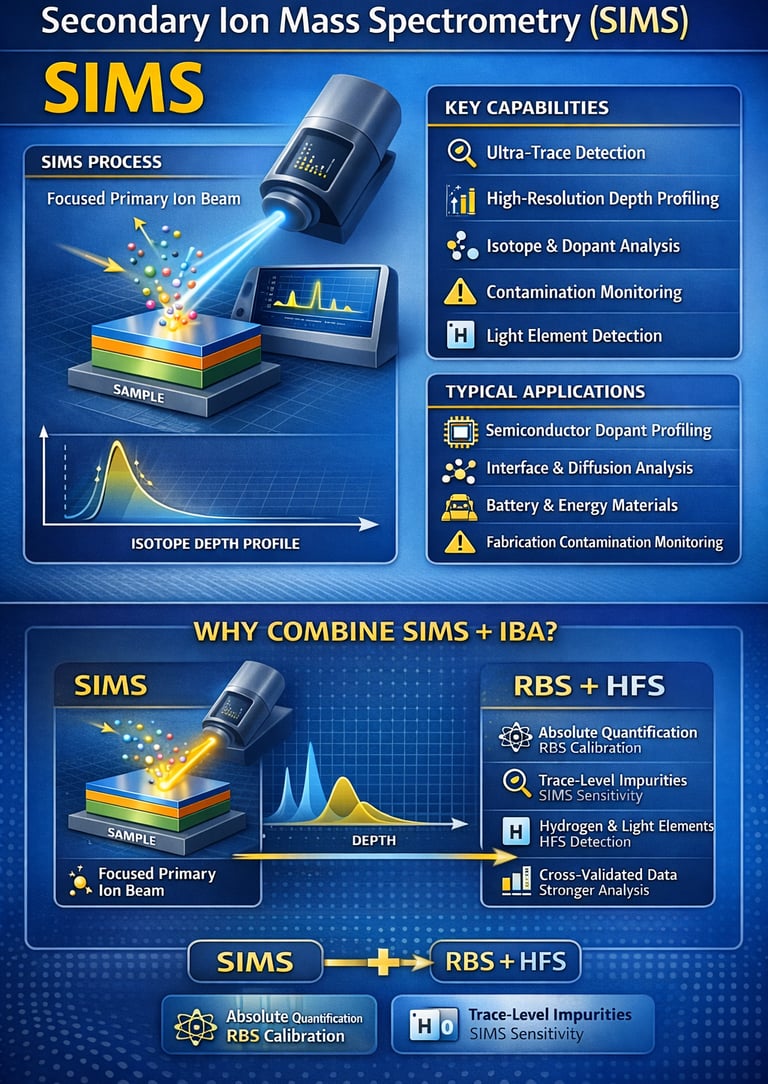
Secondary Ion Mass Spectrometry (SIMS) is one of the most sensitive analytical techniques available for elemental and isotopic analysis of thin films and semiconductor materials. At JP Analytical, SIMS enables ultra-trace detection and high-resolution depth profiling, providing critical insight into dopant distributions, contamination, and interface chemistry that directly impact device performance and yield.
By sputtering the sample surface with a focused primary ion beam and analyzing the emitted secondary ions, SIMS reveals compositional variations from the near surface down to buried interfaces with exceptional sensitivity — often reaching parts-per-billion levels.
Key Capabilities
Ultra-trace elemental detection for dopants and contaminants
High-resolution depth profiling of multilayer thin films
Isotopic analysis for process monitoring and research studies
Detection of light elements including hydrogen, lithium, and boron
Quantitative profiling when combined with standards and complementary metrology
SIMS is especially valuable for advanced semiconductor structures, ALD/CVD thin films, and emerging materials where precise control of dopant concentration and impurity levels is essential.
Applications
Dopant profiling in semiconductor devices
Interface analysis and diffusion studies
Contamination monitoring in fabrication processes
Battery and energy material characterization
Hydrogen and light-element depth profiling
Why Combine SIMS with Ion Beam Analysis?
While SIMS offers unparalleled sensitivity, combining it with techniques such as RBS and HFS strengthens quantitative confidence. RBS provides absolute composition and thickness calibration, while SIMS reveals trace-level impurities and fine depth features — together delivering a more complete materials picture for advanced R&D and failure analysis.